The History of Cheshire Mark masons
To understand where Cheshire Mark Masonry is today, you have to go back to where it started. And where it started was not tidy.
The Mark Degree in England and Cheshire, A Legacy Built on Resilience and Brotherhood
There are parts of Masonic history that get glossed over. Dates are recorded, names are logged in minute books, and the story gets filed away somewhere between the lodge accounts and the annual reports. But the story of Mark Masonry, nationally and in Cheshire in particular, is not one of those quiet footnotes. It is a proper story. One with characters who pushed back, who held their ground, and who built something that is still standing and still growing more than two hundred and fifty years later.
To understand where Cheshire Mark Masonry is today, you have to go right back to where it started. And where it started was not tidy.
The Early Origins of Speculative Mark Masonry
The shrouded history of Operative Mark Masonry stretches back much further, but the speculative story properly begins in September 1769. At a newly chartered Royal Arch Chapter, the Chapter of Friendship, meeting at the George Tavern in Portsmouth, the famous Thomas Dunckerley brought the Warrant of the Chapter and, having lately received the Mark himself, made the brethren both Mark Masons and Mark Masters, each choosing their own Mark. It is the earliest written record we have of the degree being worked in a speculative setting.
What followed was not an orderly march toward respectability. For the best part of a century, the state of the Mark Degree was, frankly, chaotic. All manner of degrees had been worked in Craft Lodges before the Union of the two rival Grand Lodges in 1813, and once that Union was settled, the Mark found itself on the outside looking in. It was not recognised as “Pure Ancient Masonry”, and it would have to make its own way.
Bon Accord and a Grand Lodge Born Out of Defiance
That making-its-own-way came to a head on 25th August 1851, when a group of London brethren founded a Mark Lodge under a Charter obtained, quite illegally, from the Bon Accord Royal Arch Chapter in Aberdeen. William Jones was appointed Master. The mother chapter in Aberdeen was not amused, and suspended the lot of them. But Bon Accord Mark Lodge thrived anyway, growing from nothing to around 150 members within five years.
In 1856, a joint committee of the United Grand Lodge of England and the Supreme Grand Chapter reported that the Mark might form “a graceful addition to the Fellow Crafts Degree”, and Grand Lodge briefly resolved that Craft Lodges could confer it. Then, at the next Quarterly Communication, that section of the minutes was simply never confirmed. The door closed almost as soon as it had opened.
So the Mark brethren opened their own door instead. Within four weeks, Grand Mark Lodge was established, with Lord Leigh as its first Grand Master. Every one of the nineteen Grand Officers appointed came from Bon Accord in London, though three other lodges, Northumberland and Berwick, Royal Cumberland of Bath, and Old Kent, were part of the founding picture too.
From there, growth was rapid. Fifteen lodges within a year. Fifty-three lodges by 1861. By 1881, two hundred and eighty-one Mark Lodges across England, Wales, and the colonies, all under Grand Mark Lodge’s authority, this despite the Craft continuing to treat it as an outsider order, and by some distance its biggest rival.
Breakaways, Loyalists, and a Few Awkward Cousins
Not everyone fell neatly into line, and that is really the heart of this story. Bon Accord’s own history of going it alone gave other lodges the confidence to do the same. Newstead Mark Lodge in Nottingham, with roots probably going back to the 1700s, declared itself independent in 1858 and even warranted two lodges of its own.
Elsewhere, the tide moved the other way. In February 1859, the Thistle Mark Lodge, then under the Scottish Constitution, now known as No. 8 EC, joined Grand Mark Lodge, encouraging other Scottish-warranted lodges to follow suit. Thistle also gave the order Frederick Binkes, who became Assistant Grand Secretary and then, from 1861, Grand Secretary, a role in which he would quietly reshape the administration of the whole order over the next three decades.
The order matured in other ways too. In 1865, at the urging of Canon Portal, Grand Mark Lodge began raising funds at charity festivals, aiming for a speedier response to need than the Craft’s more ponderous benevolence machinery. That effort became the Mark Benevolent Fund in 1868.
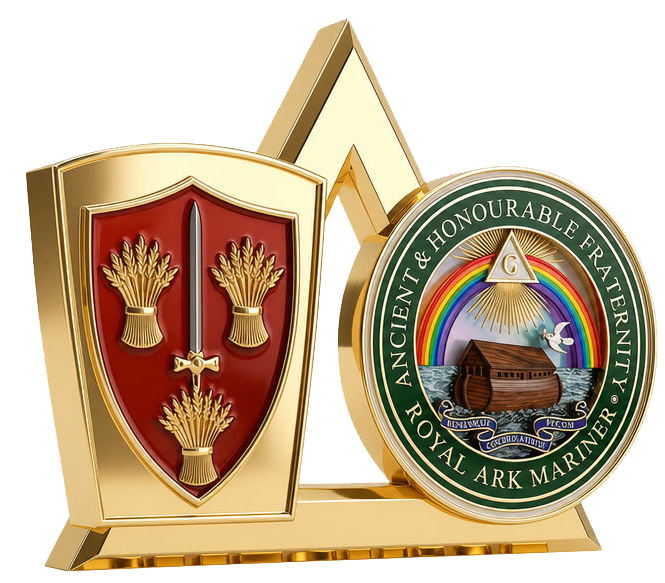
In 1871, Grand Mark Lodge took on the Royal Ark Mariner Degree, which had been suppressed by successive Craft Grand Masters since the days of the Duke of Sussex. A fraudulent “Grand Lodge of Royal Ark Mariners” had sprung up under a Brother Morton Edwards in 1870, and Grand Mark Lodge had little choice but to announce its own protection of the degree and then buy Edwards out, a deal not finalised until 1884. The receipt still hangs in Mark Masons’ Hall today.
The Craft, for its part, remained wary. In 1872 it commissioned a report into the Mark, and the resulting statement forbade any salaried Craft official from mixing with “the schismatic body styling itself the Grand Mark Lodge of England.” Strong words. But as with most Masonic disputes, time did its work, and by 1883 the Prince of Wales, Grand Master of the Craft, had been advanced into the Mark, becoming its Grand Master in 1886. He made a point of saying he wanted the Mark to remain independent of the Craft and of any other body.
Binkes finally stood down in 1889 after twenty-eight years as Grand Secretary, handing over to Charles Matier, who went on to bring many of the Additional Degrees under one roof with the Mark in London. That same year, the old colonial Provincial Grand Lodges became Districts, and the first daughter Mark Grand Lodge was formed, in New South Wales.
Cheshire’s Own Independent Streak
In Cheshire, the oldest Masonic Craft Province in the world, the Mark degree was being worked quietly in Craft Lodges long before anyone thought to formalise it. It was not a separate order with its own structure and its own Provincial oversight. It was woven into the fabric of what was already there, and often practised under Scottish warrants rather than English ones, because the Supreme Grand Chapter of Scotland kept issuing Mark charters long after the English Grand Mark Lodge had been formed, and plenty in Cheshire regarded the London body as irregular.
That detail matters. It tells you something about the independent spirit of Masonry in this part of the country. Cheshire was not waiting for permission from London. It was getting on with things in the way it saw fit.
One of the oldest lodges in the Province, Joppa No. 5 at Birkenhead, now Joppa No. 11 Time Immemorial, was first chartered under this Scottish authority between 1856 and 1858. Its original members wore Mark aprons shaped like keystones. It is a small, wonderful detail, and it says a great deal about how seriously the degree was already being taken locally, warrant or no warrant.
Ashton District: Cheshire’s Most Stubborn Lodge
If Cheshire Mark Masonry has a single character who embodies its backbone, it is Ashton District, now the Ashton District Mark Lodge, Time Immemorial, meeting at Dukinfield. In its earlier form it travelled around Cheshire, Lancashire, and Yorkshire, typically meeting within Craft Lodges on a Sunday to confer the Mark Degree and demonstrate the ceremony.
Ashton District did not take kindly to the formation of Grand Mark Lodge in London. In 1857 it went further than most and formed its own governing body, grandly titled “The Honourable United Grand Lodge of Mark Master Masons of the Ashton-under-Lyne District.” Joppa No. 5 in Birkenhead became its first subordinate lodge.
In 1870, the Deputy Provincial Grand Master of Lancashire paid Ashton District a visit, pressing the case for uniformity under the Grand Mark Lodge of England. Ashton was not persuaded. Whose uniformity, exactly? Ashton had done perfectly well running its own affairs, and it said no.
The stand-off dragged on for the best part of thirty years. In 1898, questions raised in the Masonic Record seem to have stirred Grand Mark Lodge into action, and in March 1899 the Grand Secretary sent Ashton District a blunt letter: submit, or be declared clandestine by May. It is hard not to notice the irony, given how London itself had once been treated by Scotland.
Ashton District did not back down quietly. It pointed out, quite reasonably, that it had been working its ritual openly for over a hundred years, and asked that the word “clandestine” be withdrawn. Grand Mark Lodge was unmoved, and in June 1899 declared Ashton District “spurious and clandestine” all the same.
And then, in a genuinely unexpected turn, Ashton gave in. By most accounts the change of heart came down to the persuasive powers of one Dr Foreman, who was duly rewarded with the rank of Past Grand Overseer of England for his trouble. London was delighted, Ashton was no longer spurious. On 17th February 1900, having held out longer than any other external authority, Ashton District finally submitted and received its Time Immemorial status.
The Consecration of Stamford Mark Lodge, 1872, A Turning Point
While Ashton was digging in its heels, the formal structures elsewhere in Cheshire were finally catching up with what had already been happening on the ground for decades. The consecration of Stamford Mark Lodge, No. 148, in March 1872 , now meeting at Knutsford, was the moment things began to crystallise properly.
With Stamford’s arrival, Cheshire had four Mark Lodges: Ashton District at Dukinfield, Benevolent No. 67 (now Benevolent Time Immemorial) at Stockport, Fidelity Mark No. 31 at Birkenhead, and Stamford itself. With North Wales added into the mix, several eminent Mark Master Masons judged that the time had come for a proper Provincial Grand Lodge covering the whole area.
On 5th April 1873, through the combined efforts of Brothers Bulkeley Hughes, W. Romaine Callender, J. Chadwick, Lt. Col Wilkinson, J. A. Birch, and Richard Newhouse, the Provincial Grand Lodge of Mark Master Masons of Cheshire and North Wales was instituted and consecrated. R.W.Bro. The Hon. Wilbraham Egerton, later the 1st Earl Egerton of Tatton, took the chair as the first Provincial Grand Master, and Richard Newhouse became the first Provincial Grand Secretary, a post he already held in the Craft.
Egerton was not a figure who found his way into popular history, and you would not expect him to. But within Cheshire Masonry he mattered a great deal. Building a Provincial structure from nothing, with no template and no established way of doing things, takes someone willing to shoulder that responsibility. He did. The combined Cheshire and North Wales Province separated in 1880, and the Province of Cheshire as it is known today was born.
Cheshire Mark Masonry Today, One of the Largest Provinces Outside London
It is worth pausing on that for a moment. A hundred and fifty years is a long time for anything to survive, let alone to grow. Institutions that are not genuinely useful tend to fade. They lose members, they lose energy, they lose their reason for existing.
That has not happened here. Cheshire stands today as one of the largest Mark Provinces outside London, with 39 Mark Lodges and 22 Royal Ark Mariner Lodges under its authority, and around 800 + Mark Masons and 400 + Royal Ark Mariners proudly practising the degrees.
That is not a footnote. That is a legacy, built out of defiance, stubbornness, and a fair amount of Cheshire’s own particular brand of independent spirit, and it is still being written today.